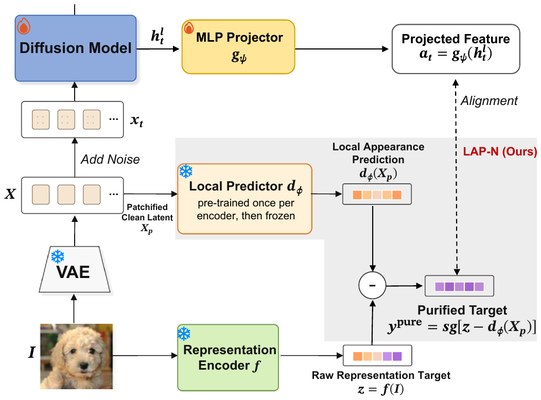
Purify Before You Align: Improving Representation Alignment for Diffusion Models
Preprint 2026
Removing locally predictable content from the teacher's features before alignment improves diffusion training, cutting FID by over 20% on ImageNet-256.

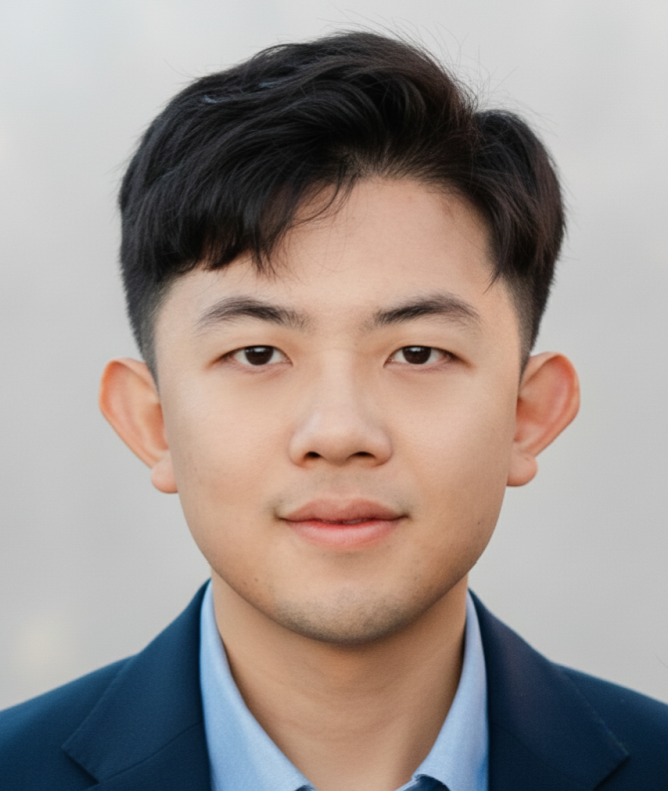
I am a final-year PhD candidate in Computer Science at Cornell University, advised by Carla P. Gomes. I also work closely with Christopher De Sa and Volodymyr Kuleshov. I am affiliated with Cornell AI for Science Institute and AI-LEAF Institute. My research studies knowledge-centric AI with an emphasis on scientific reasoning. I was also a student researcher at Amazon Grand Challenge, Amazon AWS AI Research & Education, Microsoft Research Asia, and NEC Laboratories America, where my research led to impactful papers and patents on computational antibody design, long-context protein language models, time-series representation learning, and expressive graph neural networks. My research has been generously supported by the Cornell Presidential Life Science Fellowship and the Google AI Academic Program.
I am on the 2026–27 academic job market. Please feel free to reach out!
My research develops knowledge-centric AI for scientific discovery: AI that uses scientific knowledge to shape how it predicts, learns, and reasons, especially when data are limited and predictions must go beyond observed conditions. I pursue this through three complementary approaches (scientific constraints, representations, and feedback) and help build shared infrastructure for AI and science, in close collaboration with physicists, chemists, and biologists:
Preprint 2026
Removing locally predictable content from the teacher's features before alignment improves diffusion training, cutting FID by over 20% on ImageNet-256.
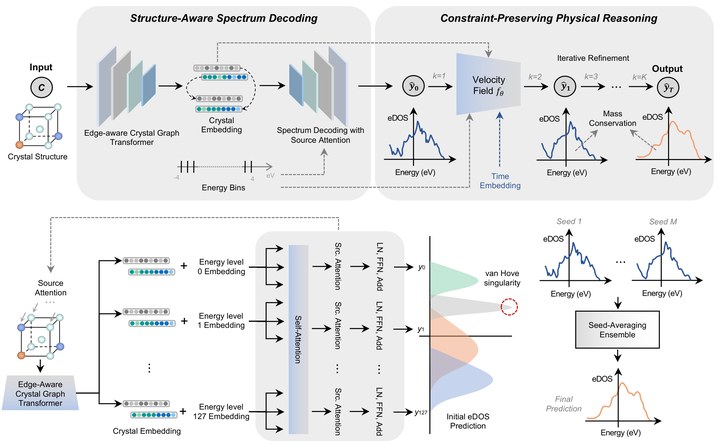
Science Advances 2026 (under review)
Paper Project Page Code Data Predictions
Spectrum predictions that conserve electronic states by construction; a DFT-validated prospective screen identified 25 materials with a rare electronic feature at nearly 10× enrichment.
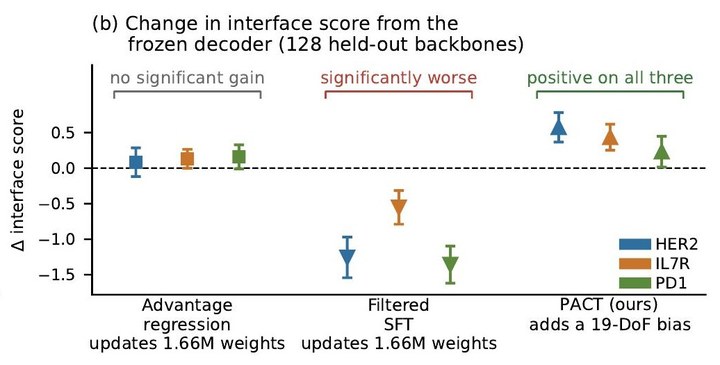
Preprint 2026
Steering a frozen antibody design model through just 19 degrees of freedom outperforms full-parameter fine-tuning across three antigens and transfers to other design models.
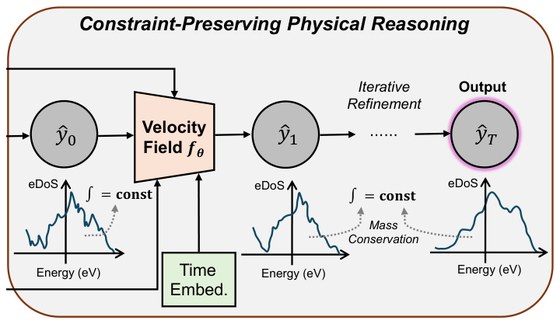
ICML 2026
A spectrum predictor that obeys physical conservation laws by construction while preserving the sharp features that matter for discovery, such as band edges.
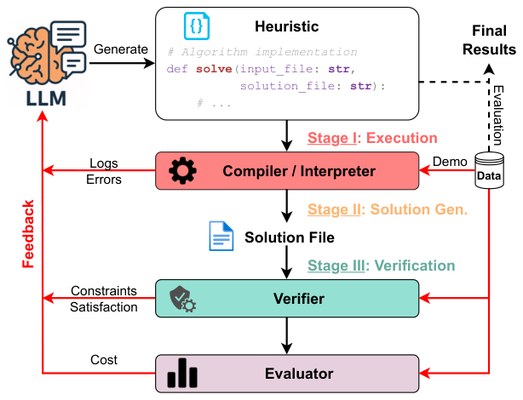
ICLR 2026
An open-ended agentic benchmark in which LLMs design heuristics for real-world scientific and engineering optimization problems, guided by verifiable execution feedback.
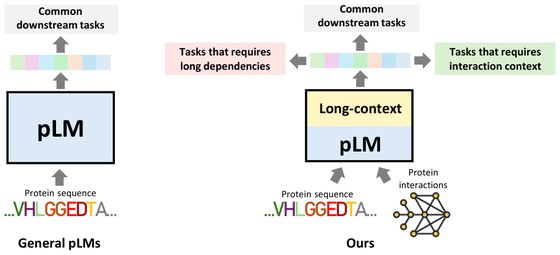
ICLR 2026 Journal Track · 🏆 TMLR Featured Paper
A long-context protein language model that captures higher-order protein interaction structure, moving beyond pairwise links and local sequence patterns.
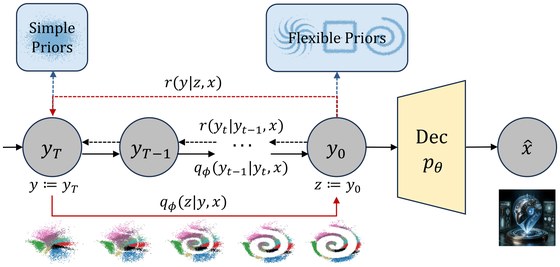
AAAI 2025
Uses diffusion models as expressive variational posteriors for approximate inference, uncovering hidden structure in data such as genetic ancestry.
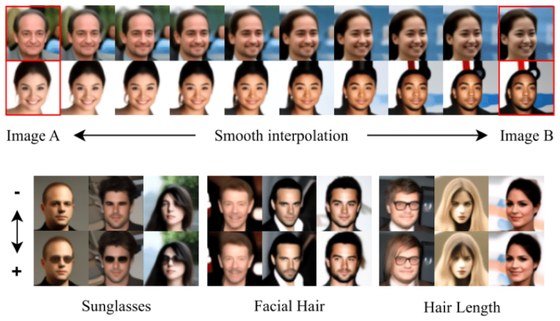
ICML 2023
Augments diffusion models with information-maximizing latent variables to learn disentangled, controllable representations.
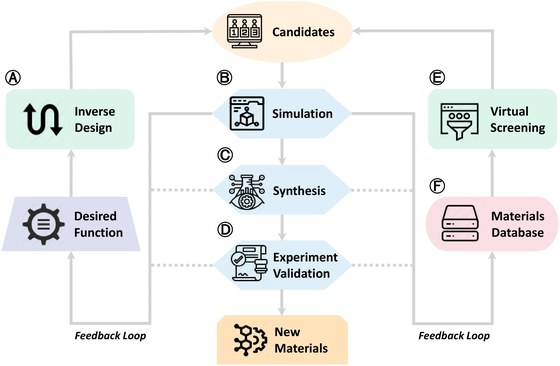
NeurIPS 2023
An integrated machine learning benchmarking platform for materials discovery, with 9 datasets and 56 tasks spanning screening, design, and simulation.
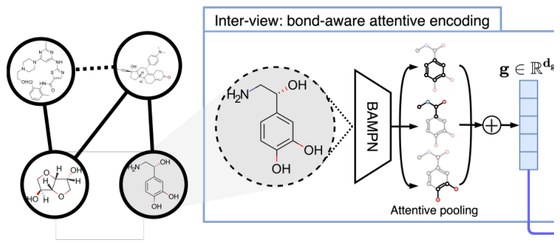
The Web Conference (WWW) 2021 · 🏆 Best Paper Award, AAAI Graph Learning Workshop
Multi-view graph contrastive learning that combines molecular structure with the drug interaction graph to predict drug-drug interactions.
Workshop Area Chair: NeurIPS (AI4Science), ICML (AI4Science).
Conference Reviewer: ICML, NeurIPS, ICLR, AAAI, AISTATS, UAI, CVPR, ICCV, ECCV, COLM, ACL Rolling Review, KDD.
Journal Reviewer: Science Advances, IEEE Transactions on Knowledge and Data Engineering (TKDE), IEEE Transactions on Pattern Analysis and Machine Intelligence (TPAMI), Transactions on Machine Learning Research (TMLR), Pattern Recognition, Bioinformatics, Journal of Biomedical Informatics (JBI).
Workshop Reviewer/PC: NeurIPS (FMTS, Math-AI, AI4Science, GenBio, GLFrontiers), ICLR (AGI, AI4Science), ICML (AI4Science), KDD (Health Day).
Others: Co-organizer of Learning on Graphs Conference (LoG 2025, 2024, 2023) workshop, Cornell CS PhD Admissions Committee Member (2025, 2024), Cornell CS Visit Day Coordinator (2025, 2024).